Monday, September 12, 2016

West With the Night--Markham's Autobiography

(Title links to synopsis.)
Markham accomplished several 
"female firsts" in her lifetime: 
first female licensed 
racehorse trainer in Kenya, 
first female to complete 
a solo flight across the Atlantic 
from east to west, and 
first female licensed 
commercial pilot in Kenya.
I became interested in reading her autobiography as a result of having read Paula McLain's historical fiction novel, Circling the Sun 
(released July 2015), which I found fascinating!
Between these two books, I feel as if I have a 
fairly comprehensive understanding of Beryl Markham, the person.
To say she was a free and independent spirit, is definitely an understatement, 
especially for the time in which she lived!

Having read Circling the Sun first I was aware of some of her earlier intimate relationships,   and rumors thereof. I felt rather surprised that she mentioned
none of her intimate relationships with men in her autobiography, 
but strictly her personal and particularly professional accomplishments. 
Then I began worrying about my own motivations! Have I fallen subject to the sensationalism that seemingly pervades current mainstream media? Yikes! I hope not...

I am fascinated by the controversy as to whether it was her third husband 
who actually wrote West With the Night or whether she wrote it herself. 
However, per Wikipedia, the publisher had paid for another book to be written by both of them, and in the meantime, her third husband refused to be involved in writing a second book, so she submitted the manuscript she had written herself and the publisher refused it, stating it was not written by the same writer as was West With the Night
One biographer found indications that her third husband had edited the WWtN manuscript, though he claimed to have changed very little. So, who knows? 
The only thing I do know for certain is that I enjoyed reading this book. :)


Charles Baldwin Clutterbuck (Yep! No lie...Clutterbuck was this man's name!) moved his family from England to Njoro in British East Africa "because it was new and you could feel the future of it under your feet." He farmed and trained and bred racehorses, though we also learn he was quite an entrepreneur, building a grist mill from two old steam engines and making money charging to mill grain for those from many many miles around. With the profit from this venture, he purchased two more old railway engines, "fitted them with pulleys, and started the first important saw mill in British East Africa." Though this is not where Markham begins telling her story...
...I am no weaver. Weavers create. 
This is remembrance--revisitation; 
and names are keys that open corridors 
no longer fresh in the mind, 
but nonetheless familiar in the heart. (3)
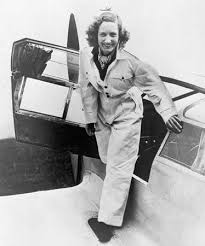
I couldn't help but sigh after reading the first two paragraphs. So true, isn't it? I love this picture on the right; she appears to be in deep thought, much as I would like to imagine she might have been as she began writing her memoir... Beryl was just over six feet tall with blonde hair and blue eyes and evidently an appealing figure. She was described as a "Society Beauty" in some headlines. She was apparently quite attractive to most men.

She begins by describing her work as a free-lance pilot flying out of Nairobi.
Even in nineteen-thirty-five it wasn't easy to get a plane in East Africa and it was almost impossible to get very far across country without one. There were roads, of course, 
leading in a dozen directions out of Nairobi. They started out boldly enough, 
but grew narrow and rough after a few miles and dwindled into the rock-studded hills, 
or lost themselves in a morass of red muram mud or black cotton soil, 
in the flat country and the valleys. (5)
It is these descriptions I love to read...I can almost imagine these 'roads' as they peter out to become nonexistent before very long. In speaking of Africa:
Whatever happens, armies will continue to rumble, colonies may change masters, 
and in the face of it all Africa lies, and will lie, like a great, wisely somnolent giant 
unmolested by the noisy drum-rolling of bickering empires. It is not only land; 
it is an entity born of one man's hope and another man's fancy. 
...there are many Africas. There are as many Africas as there are books about Africa--
and as many books about it as you could read in a leisurely lifetime...
All of these books...are accurate in their various portrayals of Africa...an Africa true to each writer of each book. Being thus all things to all authors...Africa must be all things to all readers.
Africa is mystic; it is wild; it is a sweltering inferno; it is a photographer's paradise, 
a hunter's Valhalla, an escapist's Utopia...it withstands all interpretations...
To a lot of people, as to myself, it is just 'home.' 
It is all these things but one thing--it is never dull. (8)

I think one must have a true sense of adventure to be able to do what her father did and what she did...living their lives in a scarcely inhabited environment so very different from anything in England...and definitely "wild" by comparison. 
...the soul of Africa, its integrity, the slow inexorable pulse of its life, is its own and 
of such singular rhythm that no outsider, unless steeped from childhood in its endless, even beat, can ever hope to experience it, except only as a bystander might experience 
a Masai war dance knowing nothing of its music nor the meaning of its steps. (13)
One of the things I love most about her autobiography is that she was raised alongside, actually with, the native children, so she knows of which she speaks firsthand. This is no imagined feeling about Africa, but a result of her direct experience of living in cooperation with nature, just as the indigenous people had for many generations and eons. 

Beryl describes her experience of flying during night-time: 
It is at times unreal to the point where the existence of other people seems not even 
a reasonable probability. The hills, the forests, the rocks, and the plains 
are one with the darkness, and the darkness is infinite. 
Before such a flight it was this anticipation of aloneness more than any thought of physical danger that used to haunt me a little and make me wonder sometimes 
if mine was the most wonderful job in the world after all.
I always concluded that lonely or not it was still free from the curse of boredom. (10)
I can understand a bit more about her personal relationships as a result of reading her autobiography; she definitely was never bored nor did she suffer from boredom as she was always creating and developing new relationships, never standing still nor remaining with one partner for too long.


She has landed in an out-of-the-way location of "scrubby huts" to deliver oxygen to a dying man...
Hot night wind stalked through the thorn trees and leleshwa that surrounded the clearing. 
It bore the odour of swampland, the small of Lake Victoria, the breath of weeds and 
sultry plains and tangled bush. It whipped at the oil flares and snatched at 
the surfaces of the Avian. But there was loneliness in it and aimlessness, 
as if its passing were only a sterile duty lacking even beneficent promise of rain. (18)
They ask if she won't please visit this dying man before she takes off. She finally agrees though she considers it to be a meaningless mission, at best. The man wanted news, news of the world outside his very small world.
Wherever you are, it seems, you must have news of some other place, some bigger place, so that a man on his deathbed in the swamplands of Victoria Nyanza is more interested in what has lately happened in this life than in what may happen in the next. 
It is really this that makes death so hard--curiosity unsatisfied. (25)
So bittersweet and yet so true... And although Beryl describes her total revulsion of "a human being swathed in the sickly-sweet atmosphere of disease and impending death" as much worse than her fear of any snake, I felt this was more typical of most humans than not. I believe this is due more to fear of facing our own inevitable mortality than anything else. 

In considering a fellow pilot who was lost in the Serengetti, she sees "a single jackal foraging expectantly in a mound of filth" nearby and thinks...
The sight of the jackal had brought to mind the scarcely comforting speculation that in Africa there is never any waste. Death particularly is never wasted. What the lion leaves, 
the hyena feasts upon and what scraps remain are morsels for the jackal, 
the vulture, or even the consuming sun. (23)
Add to this thought the fact that the area where the pilot was "lost" was thousands of acres of UNSURVEYED land according to the maps. This was not unusual, as much of Africa still lay unexplored. 
All this, together with the fact that there was no radio, nor any system designed to check planes 
in and out of their points of contact, made it essential for a pilot either to develop 
his intuitive sense to the highest degree or to adopt a fatalistic philosophy toward life. 
Most of the airmen I knew in Africa at that time managed to do both. (36)
I feel Beryl had the added advantage of knowing Africa from a 'native' perspective, having hunted and lived with the indigenous people as a child. Bishon Singh is in the Serengetti as she rescues Woody, that lost pilot. Bishon speaks to Beryl of flight:
'So,' he scolded, 'now it has come to this. 
To walk is not enough. 
To ride on a horse is not enough.
Now people must go from place to place through the air, 
like a diki toora
Nothing but trouble will come of it, Beru. 
God spits upon such blasphemy.'
'God has spat,' sighed Woody. (52)
Thank goodness for Beryl's commitment to keep flying over those thousands of acres in the Serengetti and looking, always looking, for just one little clue...and she almost missed it, thinking it a strange little bit of water, then realizing it was the sun reflecting off the wing of Woody's plane. She was quite a courageous soul! 

She describes a huge herd of impala, wildebeest, and zebra, fleeing "before the shadow of my wings," as she explores the Serengetti searching for Woody:
As the herd moved it became a carpet of rust-brown and grey and dull red.
It was not like a herd of cattle or of sheep, because it was wild, and it carried with it the 
stamp of wilderness and the freedom of a land still more a possession of Nature than of men. 
To see ten thousand animals untamed and not branded with the symbols of human commerce 
is like scaling an unconquered mountain for the first time, 
or like finding a forest without roads or footpaths, or the blemish of an axe. 
You know then that what you had always been told--that the world once lived and grew 
without adding machines and newsprint and brick-walled streets and the tyranny of clocks. (38)
I don't know about you, but I can remember a similar sense of awe and spiritual presence as I watched herds in the wild shown on nature shows I would watch on TV as a child. I guess I have always been drawn to the seemingly fluid movements of herds of thousands of wild beasts. 

The sikh, Bishon Singh, who had been the first one on the scene when Beryl was attacked by a 'pet' lion as a child, had himself later been attacked by a lion, which he believed made the two of them like "brothers." Beryl devotes a whole chapter to this life event, "He Was a Good Lion," which might seem incongruous, given the fact that he had attacked her and continued to kill over the next three nights: a horse, a yearling bullock, and "a cow fresh for milking," until finally captured and caged to live out the "many many years" remaining in his life. 
It seems characteristic of the mind of man that the repression of what is natural to humans 
must be abhorred, but that what is natural to an infinitely more natural animal 
must be confined within the bounds of a reason peculiar only to men--
more peculiar sometimes than seems reasonable at all...
He had lived and died in ways not of his choosing. He was a good lion.
He had done what he could about being a tame lion. 
Who thinks it just to be judged by a single error?
I still have the scars of his teeth and claws, but they are very small now and almost forgotten, 
and I cannot begrudge him his moment. (66)
Beryl herself could understand that this 'tame' lion who was allowed to run loose on the Delamere's estate would attack her as she ran carelessly through the wild growth near the farm. She certainly seemed to suffer no long-term physical effects. She was especially close to Delamere and his wife:
Delamere had two great loves--East Africa and the Masai People. 
To the country he gave his genius, most of his substance, and all of his energy. 
To the Masai he gave the help and understanding of a mind unhampered by the smug belief
that the white man's civilization has nothing to learn from the black man's preferred lack of it. 
He respected the spirit of the Masai, their traditions, their physical magnificence, 
and their knowledge of cattle which, excepting war, was their only concern...
Delamere's character had as many facets as a cut stone, 
but each facet shone with individual brightness. (71)
According to Beryl, the Delamere estate became "an exemplary farm for all of British East Africa to profit by, but almost a small feudal state as well." 
...if Delamere was the champion of the East African settler (as indeed he was), then the devotion and comradeship of his wife were as responsible for his many victories as his own genius. (72)
Lady Delamere had served as Beryl's "adopted mother" and of her Beryl states,
I cannot remember a time when her understanding 
of my youthful problems was lacking or her advice withheld. (72)
I did chuckle at that last phrase regarding advice! :) That proved to me she did act more like a mother to Beryl than not. At least Beryl did have some adults who helped raise her through childhood. 

Buller, Beryl's faithful canine companion, was abducted from the hut he shared with Beryl one night by a leopard, and when she finally found him the next morning, he was barely alive, but following 10 months of "tedious nursing" he "became the same Buller again--except that his head had lost what little symmetry it ever had and cat-killing developed from a sport to a vocation." Years later he attacks a warthog about six times his size, and is torn open, but recovers once again. But even Buller's life finally ends...
What can be said of Buller--a dog like any other, except only to me? 
...Rest you, Buller...There is respect for a heart like yours, and if its beating stop,
the spirit lives to guard the ways you wandered. (136)
This made me tear up, having lost my childhood canine companion as a senior in high school. Being an only child living in the country on a farm, my dog was quite literally my best friend. :)

The first foal that Beryl births on her own with the help of Otieno and Toombo is given to her by her father. She names him Pegasus. It is on Pegasus that she sets out once her father has lost his farm...toward the stables at Molo where her father believes she can learn to train horses...as a professional. 
Remember that you are still just a girl and don't expect too much...work and hope. 
But never hope more than you work. (135)
It is on this long trip that she and Pegasus happen upon Tom Black, working to get his car running again... He shares with her his dream to own his own plane and fly again, having flown in the war.
It makes you feel bigger than you are--closer to being something you've sensed you might be capable of, but never had the courage to seriously imagine. (153)
He had been lavish with a stranger. He had left me a word, tossed me a key 
to a door I never knew was there, and had still to find...
Whoever heard of Destiny with pliers in his hand? (154)
It was many days before their paths crossed again, but he had an indelible affect upon Beryl's life. And although Tom accomplished much in his life, 
If a man has any greatness in him, it comes to light, 
not in one flamboyant hour, but in the ledger of his daily work. (153)
What a revealing insight...I so agree! It is easy for a person to be impressive or do something impressive once or for a short while, but what reveals a person's true character is his/her daily thoughts, intentions, actions and interactions, isn't it? He had planted a seed...and it grew over time...

I'm no horsewoman, but the description of one race where Beryl had trained the favored colt to be a champion only to have him stripped away from her at the last minute and she hurriedly trains another smaller filly with bad legs...the description of that race as she watches these two horses...it's so full of tension and such bursts of feelings! She states that you do not "watch" a horse race, you "read" it. And poor Beryl! Both of them race their hearts out...and does her handicapped little filly win it? Yes...she even sets a track record! Though the owner wisely retires her, ignoring the money that might be made by continuing to race her. That made me so happy. Why risk her legs breaking down just to get more money? No. Have a heart and care for her. Just celebrate her victory! That's so right...

Beryl did learn to fly and in the aftermath...
Life had a different shape; it had new branches and some of the old branches were dead.
It had followed the constant pattern of discard and growth that all lives follow. 
Things had passed, new things had come. The wonder of my first fledgling hours of flight were lost in the many hundreds of hours I had sat making my living at the controls of my plane. (197)
Flight is but momentary escape from the eternal custody of earth. (285)

In describing Denys Finch-Hatton (of Out of Africa fame):
If someone has not already said it, someone will say that he was a great man who 
never achieved greatness, and this will not only be trite, but wrong; 
he was a great man who never achieved arrogance. (192)
What came from him, if emanate is not the better word, was a force that bore inspiration, 
spread confidence in the dignity of life, and even gave sometimes a presence to silence. (193)
Denys had invited Beryl to fly with him as he tried out his theory of scouting elephant overhead by airplane for hunting parties. (After reading The Elephant Whisperer by Lawrence Anthony and learning more about elephants, particularly their intelligence and communicative abilities, I was sickened by this talk of hunting elephants, but it is what was done at that time...) When Beryl mentioned it to Tom, he asked her to wait and not go with Denys on that day. Then her native companion later asked if she had heard from Denys. Somehow both of them had premonitions...for Denys and his Kikuyu boy died at the beginning of that flight...the plane simply 'crashed and burned.' 
Denys' death left some lives without design, but they were rebuilt again, 
as lives and stones are, into other patterns. (196)

Beryl's opinion:
As to the brutality of elephant-hunting, I cannot see that it is any more brutal than 
ninety percent of all other human activities. I suppose there is nothing more tragic about 
the death of an elephant than there is about the death of a Hereford steer--
certainly not in the eyes of the steer. 
The only difference is that the steer has neither the ability nor the chance 
to' outwit the gentleman who wields the slaughterhouse snickersnee, 
while the elephant has both of these to pit against the hunter. (208)
The older I get the more I realize that ALL beings, animals and plants, in this world are more than we humans believe them to be. I get her point about the steer. And having said all this, you would believe me to at least have adopted a vegetarian lifestyle, if not vegan, but I have not. Perhaps old habits die hard...and I must eat--something! :) According to her, elephants will always simply charge and kill a man. Though she and Blix were not dispatched in this way by one elephant they encountered, though it could have done just that with both of them... Wow...how scary would that be? According to Blix, there is an old adage translated from the Coptic
that contains all the wisdom of the ages--
"Life is life and fun is fun, but it's all so quiet when the goldfish die." (219)
Beryl's philosophy on life:
A life has to move or it stagnates...
It is no good telling yourself that one day you will wish you had never made that change; 
it is no good anticipating regrets. 
You learn to watch other people, but you never watch yourself 
because you strive against loneliness. 
Being alone in an aeroplane...irrevocably alone, with nothing to observe but...
the beliefs, the faces, and the hopes rooted in your mind--
such an experience can be as startling as the first awareness of a stranger 
walking by your side at night. You are the stranger. (283)
Oh, I think Beryl's on to something here. I firmly believe that few of us ever take enough time to be by ourselves, just to contemplate and wonder...about everything, life, death, all that lies behind and before us. As a species I believe the majority of us have not discovered and certainly not nurtured our introspective skills...and I believe we have lost much along with the loss of such abilities. 

Reading the last 20 pages or so of this book as Markham describes her record-breaking flight was tense! If you want to know just how brave and courageous she had to be to survive it, then you should read her account. Wow. She ended up crash-landing...so definitely not strictly according to plan, but she accomplished the main goal! And yes, that is a bandage on her head. Fortunately, a Cape Breton Islander found her...
I had been wandering for an hour and the black mud had got up to my waist 
and the blood from the cut in my head 
had met the mud halfway. (290)
She discovers that Tom has died, at the controls of his plane. And then she is traveling by ship back to...Africa, ostensibly to see her father. Taking with her many of the newspaper clippings about her record-breaking flight...as well as some of the articles written about Tom. 


As I look at these pictures
of her, I keep reminding
myself that she stood over
six feet tall.
She was quite tall and 
very good looking...
and definitely...
brave, courageous,
and never ever
stagnant!

I stumbled across this 1993 review of The Lives of Beryl Markham by Errol Trzebinski 
in the Independent, and now I really want to read it! 

And I feel as if I want to accompany these two books by also 
reading Out of Africa by Isak Dinesen/Karen Blixen. 
I watched the movie once, many years ago, 
and enjoyed it very much! Definitely do for a 'rewatch'!
I might as well add her Shadows on the Grass, too, 
since these five stories were a follow-up to Out of Africa

If you feel at all interested in this book, 
I strongly recommend it as an informative yet intriguing read!

Do you know much about Markham?
I am glad to have learned so much about her life.
In many ways I keep comparing what I know of 
Anne Morrow Lindbergh's life and Markham's. 
(I read and loved The Aviator's Wife by Melanie Benjamin!)
They were both female aviators at a time when only males flew planes!
They both accomplished female firsts, but were seemingly quite different people.
Though, as I consider, they also had some things in common.

Happy reading
--Lynn

Tuesday, September 6, 2016

My first Vonnegut...uhm...

or The Children's Crusade 
I'm going to assume this was perhaps not the best Vonnegut 
to make my first reading experience with this writer.
I will try reading Breakfast of Champions next since 
one of my friends stated it is her favorite Vonnegut.
This will probably be one of the shortest blog posts I've ever done!
There just isn't much I want to say...
except...this did not resonate with me much. 
I think it was mainly Vonnegut's writing style; at least in this book,
it is as if there are bits and pieces rather disconnected, though some are interwoven,
I was rather confused and much of the time felt similarly as when I read
The Stranger by Albert Camus.
Though with Camus' book I felt there was a story, strange and nonsensical as it seemed, 
whereas with this book I felt as if I was reading stream-of-consciousness as the
author had memories or thoughts. 
As I read where I had marked, I realized it was a bit more coherent and cohesive than
I remember it being, but still not a reading experience I wish to repeat! 
So, I read this classic. And I have now read a Kurt Vonnegut.
That is the best I can say of this one...

Although I had many markers in this book when I finished reading it, I was aware they were more to try to help me understand this work than items I wanted to quote or make note of in a review. And...did it work to help me better understand? I certainly hope so... 

In the preface Vonnegut admits he has "no regrets about this book," though it has been said it "trivialized the Holocaust." He describes it:
It is a nonjudgmental expression of what I saw and did in Dresden after it was firebombed 
so long ago, when, in the company of other prisoners of war and slave laborers 
who had survived the raid, I dug corpses from cellars and carried them, unidentified, 
their names recorded nowhere, to monumental funeral pyres. 
The corpses could have been anybody, including me, and there were surely 
representatives among them, whether collaborators, or slaves, or refugees, 
of every nation involved in the European half of World War II. 
How could I be nonjudgmental? It was bombs that had done the killing.
I had several decent and honorable and courageous friends who were pilots and bombardiers.
Actions of men like them on the Dresden raid required no more fury and loathing or angry vigor 
than would have jobs on an automobile assembly line. (xii)
So I guess they were just 'doing their job'? Well, yes, perhaps...but... When considering war and how humans can be so inhumane to others of their own species, I am always reminded of All the Light We Cannot See (by Anthony Doerr) and how in both the book club discussions in which I participated so many readers stated this was the first time they felt they could understand how a person could participate in war and kill others; how we could become convinced to do so, particularly for a madman like Hitler. So, yes, in a way, it is just 'doing a job,' and yet... 

Vonnegut continues:
The drama at Auschwitz was about man's inhumanity to man.
The drama of any air raid on a civilian population, 
a gesture in diplomacy to a man like Henry Kissinger, 
is about the inhumanity of many of man's inventions to man. (xiii)
But...there is no difference, in my humble opinion--inhumanity and indiscriminate murder is just that, whether inflicted by one person upon another with a knife, gun, or hand-to-hand combat, or by flying a plane that drops bombs onto people. Though admittedly, to drop bombs does remove a layer of culpability by eliminating personal contact with the victims of your weaponry, but it doesn't remove your responsibility for killing others. Or is Vonnegut just simply being satirical? Definitely up to a reader's interpretation...

In discussing the writing of this book with his friend, O'Hare, he states
"I think the climax of the book will be the execution of poor old Edgar Derby...
The irony is so great. 
A whole city gets burned down, and thousands and thousands of people are killed. 
And then this one American foot soldier is arrested in the ruins for taking a teapot.
And he's given a regular trial, and then he's shot by a firing squad."
Definitely irony in that. Sick irony, but...irony. It is said that 130,000 people died in the Dresden bombing. Did you get that? One. Hundred. Thirty. Thousand. People. Dead. All in one city. 

Many years later, he wrote the Air Force,
asking for details about the raid on Dresden, who ordered it, how many planes did it, 
why they did it, what desirable results there had been and so on. 
I was answered by a man who, like myself, was in public relations.
He said that he was sorry, but that the information was top secret still.
I read the letter out loud to my wife, and said, "Secret? My God--from whom?" (10-11)
In such instances, I wonder exactly who is in control of such decisions and what their ulterior motives might truly be. Who knows? Will we ever know? Only many decades later, as has been the way of it. Interestingly, this book was published in 1969. A very tumultuous time in U.S. politics and society, where upheaval and protest were the norm. 

Vonnegut couldn't help but notice that Mary, O'Hare's wife, had a particularly cold attitude toward him. She did finally express what was bothering her: It was the fact that he was writing a book about war, and in her opinion "wars were partly encouraged by books and movies," in that it idealized war and glossed over the fact that they were "fought by babies like the babies upstairs." From this he felt her anger was not directed toward him, but toward the concept of war:
She didn't want her babies or anybody else's babies killed in wars. (14)
Yes, who does? And yet when the world is faced with a madman like Hitler, who has been allowed to grow so strong, what else is to be done? Though what of the bombing raid on Dresden? Why? Exactly what "good" was to result? It is a conundrum to be sure... I personally feel violence only begets more violence, but there have been times when it was necessary, haven't there? 

Vonnegut gives us a brief account of the actual "Children's Crusade" begun in 1213 by two monks who had the 'brilliant' idea of 
raising armies of children in Germany and France, and selling them in North Africa as slaves.
Thirty thousand children volunteered, thinking they were going to Palestine...
about half of them drowned in shipwrecks...
the other half got to North Africa where they were sold. (15-16)
What?!? I had never heard of such a thing. Honestly, what we humans have done and can and evidently will do to each other. Horrific... "So it goes." Vonnegut repeated this one phrase throughout this book more times than I could (or wanted) to count. 

The Billy Pilgrim portions of this book sometimes reminded me just a bit of Douglas Adams' The Ultimate Hitchhiker's Guide to the Galaxy. But only a bit and only for a moment every now and then. Did I mention Vonnegut's writing style in this one did not resonate well with me? Yeah...it didn't...

One character, Weary, is obviously a psycho, and he ends up with Billy Pilgrim, in the middle of World War II. Bizarre. Nonsensical. Random. Two scouts ditch them in a creekbed and soon after are shot by Germans. Absurd? Ironic? 

Billy Pilgrim is abducted by Tralfamadorians:
"Welcome aboard, Mr. Pilgrim," said the loudspeaker. "Any questions?"
Billy licked his lips, thought a while, inquired at last: "Why me?"
"That is a very Earthling question to ask, Mr. Pilgrim. Why you? Why us for that matter?
Why anything? Because this moment simply is. Have you ever seen bugs trapped in amber?"
"Yes," Billy, in fact, had a paperweight in his office 
which was a blob of polished amber with three ladybugs embedded in it.
"Well, here we are, Mr. Pilgrim, trapped in the amber of this moment. There is no why." (73-74)
It does seem that way at times, doesn't it? 
"If I hadn't spent so much time studying Earthlings," said the Tralfamadorian, 
"I wouldn't have any idea what was meant by 'free will.' 
I've visited thirty-one inhabited planets in the universe, 
and I have studied reports on one hundred more.
Only on Earth is there any talk of free will." (81) 
Hah! What fools? Or at the very least idealists? 

Rosewater was reading a book entitled Maniacs in the Fourth Dimension by Kilgore Trout, 
about people whose mental diseases were all in the fourth dimension, 
and three-dimensional Earthling doctors couldn't see those causes at all, or even imagine them.
One thing Trout said that Rosewater liked very much was that there really were vampires and werewolves and goblins and angels and so on, but that they were in the fourth dimension.
So was William Blake, Rosewater's favorite poet, according to Trout.
So were heaven and hell. (99)
Ha! I had to chuckle at that last line. Yep! Vonnegut was an atheist and humanist. :)

Rosewater congratulates Billy Pilgrim's fiancee on her engagement ring,
"Thank you," she said, and held it out so Rosewater could get a close look.
"Billy got that diamond in the war."
"That's the attractive thing about war," said Rosewater.
"Absolutely everybody gets a little something." (105)
Ugh. How facetious is that statement? 

According to the Trafalmadorians, Earthlings might learn to "Ignore the awful times, and concentrate on the good ones" if they just tried hard enough. I agree that we need to concentrate much more effort on remembering and celebrating the positives in life. 

Americans, like human beings everywhere, believe many things that are untrue...
Their most destructive untruth is that it is very easy for any American to make money.
They will not acknowledge how in fact hard money is to come by, and therefore,
those who have no money blame and blame and blame themselves.
This inward blame has been a treasure for the rich and powerful, 
who have had to do less for their poor, publicly and privately, 
than any other ruling class since, say, Napoleonic times.
Many novelties have come from America. The most startling of these,
a thing without precedent, is a mass of undignified poor. 
They do not love another because they do not love themselves. (123)
Amazing how 47 years later these words are still prophetic. Sad...

I admit this did make me chuckle:
Trout, incidentally, had written a book about a money tree. It had twenty-dollar bills for leaves.
Its flowers were government bonds. Its fruit was diamonds. It attracted human beings 
who killed each other around the roots and made very good fertilizer.
So it goes. (159)
Ugh. All too true... Quite easy to imagine, isn't it? It happens every day...

I'll end with this tidbit...
Robert Kennedy, whose summer home is eight miles from the home I live in all year round,
was shot two nights ago. He died last night. So it goes.
Martin Luther King was shot a month ago. He died, too. So it goes.
And every day my Government gives me a count of corpses created by military science in Vietnam.
So it goes.
My father died many years ago now--of natural causes. So it goes. He was a sweet man.
He was a gun nut, too. He left me his guns. They rust. (200)

Okay, maybe not so short a review after all! :)
While there are some gems in here, I can't say I really enjoyed reading this book.
I get the symbolism, the seeming inevitability of war, the hopelessness of humanity,
the inhumanity of humanity...

To say this was not an optimistic or positive read is a definite understatement. 
Though it contains many truisms.

Have you read this book?
Any other Vonnegut novels you might recommend that might be a bit 'lighter' fare?

Happy reading
--Lynn

Monday, September 5, 2016

Little House Read-Along for September: The First Four Years

Little House Read-Along 2016
#LittleHouseRAL
I so loved reading These Happy Golden Years!

I admit that in researching I did read of some not-so-great events 
in Laura's adult life, so am a bit hesitant about this last book in the series, 
I realize heartbreak is part of life, but These Happy Golden Years 
was so optimistic, upbeat, and enjoyable overall! 
I'll just have to keep that positive spirit in mind!
In reading the introduction to this book, 
I have learned it was published following the death of Rose, 
by her long-time friend and lawyer, Roger MacBride.
No editing was done to Laura Ingalls Wilder's original composition;
it was published just as she wrote it as a first draft.
It will be interesting to see how much differently 
this might read than the other books which Rose edited.

Then we will move on to other books written and published by Wilder 
and others about her and her daughter, Rose.

I read the first two of these just before reading the series.

What impressed me most was the writing style. 


                              by Laura Ingalls Wilder and Rose Wilder Lane

                              by Laura Ingalls Wilder, Roger Lea Mac Bride, 
                                   Margot Patterson Doss

December 2016       A Wilder Rose by Susan Wittig Albert and/or
                              Pioneer Girl by Laura Ingalls Wilder, Pamela Smith Hill
                              Albert is one of my favorite authors and I am sure I'll                                                  enjoy the writing in A Wilder Rose.
                              I already own a copy of Pioneer Girl and am planning to 
                                   start reading it in October so I can take my time and 
                                   read a bit at a time. It is quite large!

So, here we go...the last official installment of the Little House book series,
though not the end of our Read-Along! :)

I do not yet have the Linky link-up, 
so please go to Bex's posting to register for now... :)

Laura finds love...of horses and man! :)

Oh, this book! Such a beautiful story of love...
What a marvelous re-entry to the reading and blogging world 
after an almost 3-week-long hiatus due to work! 
No, this was not a self-imposed absence, but necessary, since I am old! :)
I've worked 55-60 hours each of the past 3 weeks and am so tired...
physically...and of this job!! I am hopeful that I will have a different job soon!
My apologies for being such a pitiful Read-Along cohost this month! 
But back to this gorgeous little book!
I know I've said this every time during this Little House Read-Along (#LittleHouseRAL),
but, really, I think this may be my favorite of the series!
Be sure to check out everyone else's reviews on the Little House Read-Along page!
The consensus seems to be that this one ranks as most everyone's favorite in the series!


Fortunately, Bex was much more efficient this month. Here is her THGY review

Laura begins teaching at the age of 15! Wow! That's young, especially when you stand only 4 feet 11 inches tall! And...you're a female! I adored the advice Pa gave her as they drove the 12 miles to the Brewster's who lived 1/2 mile from the schoolhouse where she would teach for 2 months. In reminding Laura of the time she got all the wood hauled into the house by herself on Plum Creek when he and Ma had gone to town and a blizzard had hit:
"That's the way to tackle things!" Pa said. 
"Have confidence in yourself and you can lick anything. 
You have confidence in yourself, that's the only way to make other folks have confidence in you."
He paused, and then said, "One thing you must guard against." 
"What, Pa?" Laura asked.
"You are so quick, Flutterbudget! You are apt to act or speak first, and think afterward.
Now you must do your thinking first and speak afterward.
If you will remember to do that, then you will not have any trouble." 
"I will, Pa," Laura said earnestly. (3-4)
I could so appreciate this advice; I wish someone had said the exact same thing to me when I was younger...it took many years for me to learn this lesson! :) And as usual, Laura does not forget Pa's well-meaning and timely advice; his words echo in her mind many times over these next weeks... Staying with the Brewster's demonstrated a whole new world to Laura, one in which people did not treat each other respectfully, a mother who did not properly care for her child, and eventually she is exposed to a psychotic episode in the middle of the night. This was so scary for Laura! But as she noted at the end of only her first day of school, 
I have only to get through one day at a time...
It was hard to stay where she was not wanted. She took care to make no work for Mrs. Brewster, and to help her all she could. [The second morning] politely she said, 
"Good morning," and smiled, but she could not keep on smiling.
She had not known before that it takes two to make a smile. (2)
I loved Laura's maturity at this realization! It does indeed take two to make a smile continue, doesn't it? You can seemingly only keep it going for a bit if the other person does not respond in kind.

But Laura does have an unexpected surprise at school on that first Friday afternoon...when she hears sleigh bells and sees Prince and Lady pass by the school's window. As she closes and locks the front door, none other than Almanzo is waiting for her in the brand new cutter he made! I am convinced Almanzo was well aware of at least some of the problems Laura may encounter staying with the Brewster's and was determined to rescue her each weekend he could. I loved him for that. I had to chuckle at Laura's joy being home for the weekend and her realization on that Saturday morning:
She had quite forgotten that she had ever disliked the town. 
It was bright and brisk this morning. Sunlight glinted on the icy ruts of snow 
in the street and sparkled on the frosty edges of the board sidewalk. (37)
I rather believe that if they had still been living on the claim, she would have waxed just as romantically about that, too. It was being home that made the most difference to her, in my opinion. :) And understandably so. So much better than being stuck at the Brewster's! 

With only three more weeks to teach, Laura finally decided to "stop shilly-shallying" and admit the truth to Almanzo. As they near the Brewster's she tells him,
"I am going with you only because I want to get home. 
When I am home to stay, I will not go with you any more. 
So now you know, and if you want to save yourself these long, cold drives, you can." (62)
Though I felt they really took too much of a chance the very next weekend that it was 40 degrees below zero! They had to stop every little bit to clear the horse's noses and mouths so they wouldn't freeze, and I was fearful Laura would be frostbitten before they made the 12-mile trek. But they did make it, and Laura literally had to thaw out in front of the stove when she finally arrived home. Everyone was safe in the end, Laura, Almanzo, Prince, and Lady! YAY!! I breathed a huge sigh of relief! Almanzo later admitted to Laura that if not for Cap Garland's off-hand comment that "God hates a coward," while Almanzo was looking at the thermometer just before he left town to come for her on that Friday afternoon, he might not have risked the trip. Laura asks him, "So you came because you wouldn't take a dare?" Almanzo replies, "No, it wasn't a dare. I just figured he was right." :) And that sweet Alamanzo, even after Laura's declaration of not going with him any more, he still perseveres to transport her every weekend. That man is a saint! And Laura surprises herself by 'forgetting' this declaration and sleigh-riding with him as all the other couples are doing so throughout town, up and down main street! 

I loved how Almanzo got jealous of "the man" Laura "was talking with" when he picked her up to go riding with Mary Power and Cap, come springtime. How sweet! He really cares for her! I will say...Laura was never idle! Even if she was teaching throughout the week, she would still go into town and work all day hand-sewing each Saturday. She was a hard worker! Then she takes a "job" as a companion to a woman and her daughter as they live out on the claim while the husband/father works in town to make money so they can eat and survive. It was eye-opening to hear this wife cite the unfairness of the law requiring someone to live on the claim for seven years before the land becomes their own. I hadn't before considered the hardship this might place on the women/families. Laura's Pa was lucky enough to be close to town and able to walk or ride back and forth easily enough to do carpentry work when he wasn't busy working the farm in summertime. Other men had to go away to work during the summertime, too. 

Pa has already got the "itch" to relocate, but Ma is determined they are "settled" and he admits he does want to stay to prove the homestead claim. Though Laura recognizes this impatient look in his eye and thinks to herself that she is the same, not wanting to be "shut up in a schoolroom," but determined to teach to make money. It is during her second teaching stint (at a school very close to home, this time) that Pa comes up with a plan to purchase an organ and have it at home for Mary to play over the summer when she is out of school. They are all thrilled with this surprise...then Mary sends a letter stating that she wants to spend her summer with a friend from school at her house. Though it is a shock, especially to Ma and Laura, they all manage to accept it and are glad Mary has this opportunity.

Laura is all dressed up in her newest dress and "poke bonnet" and Carrie says,
"When I'm a young lady, I'm going to earn me a dress just exactly like that."
"Likely you'll have a prettier one," Laura answered quickly, but she was startled.
She had not thought that she was a young lady. Of course she was, 
with her hair done up and her skirts almost touching the ground. 
She was not sure she liked being a young lady. (164)
Aha! New territory, this "young lady" stuff, isn't it? :) Fortunately, once they were home from church that Sunday, she didn't change out of her brand-new dress, as usual. Of course, after describing all the underclothing and underskirts she had to put on, I wouldn't change either! Geeminy! It must have taken forever to get all that clothing on and properly aligned! Soon she saw a buggy come trotting toward the house, pulled by the two colts she had helped break behind the cutter that winter! But when Almanzo placed his arm along the back of the buggy seat and didn't move it when she shrugged, she gently shook the buggy whip, just enough to spook the colts who then broke into a run. "You little devil," Almanzo exclaimed! Almanzo is learning the hard way just how independent Laura is! I had to laugh at Almanzo's comment as they are returning home from this first ride in the new buggy:
"This country is settling up fast," Almanzo said as they turned west 
along the shore of Silver Lake and so toward Pa's claim. 
"We have driven only forty miles and we must have seen as many as six houses." (169)
Oh, my, that sounds even worse than me. Most of my life I have lived in the country with the nearest neighbor 1/4-1/2 mile away. And I admit I much prefer it that way. Living in town is not my cuppa tea, so to speak! Laura has even more adventures with horses and colts in her future with Alamanzo. He registers them for "singing school" in De Smet and has her handle the horses and wagon while he waits to jump in. She has to circle the school many times before he can get the timing just right to hop in and she is rather exhausted from handling the horses all that while, though she settles in and enjoys it. At one point she is driving as they go through town on the Fourth of July and everyone is just staring at her! 

Laura gets another teaching job, for three months this time and is able to stay with her friend, Florence, during the week. Since Florence didn't pass the teacher certification test but knew Laura had, she suggested her father hire Laura to teach at his new school. 
"Thank you, Florence, so much!"
"Well, you have always been so nice to me, I am glad of a chance to pay some of it back," 
Florence told her. 
Laura remembered what Ma had said about luck, and she thought to herself:
"I believe we make most of our luck without intending to." 

On one of their long rides, Laura sang Alamanzo's favorite song for him, then she said...
"I've sung for you, now I'll give you a penny for your thoughts."
"I was wondering..." Almanzo paused. Then he picked up Laura's hand that shone white in the starlight, and his sun-browned hand closed gently over it. He had never done that before.
"Your hand is so small," he said. Another pause. 
Then quickly, "I was wondering if you would like an engagement ring."
"That would depend on who offered it to me," Laura told him.
"If I should?" Almanzo asked.
"Then it would depend on the ring," Laura answered and drew her hand away. (214)
The next Sunday Alamanzo arrived later than usual. They went to Lake Henry and ate of the frosted wild grapes. 
As they drove home the sun went down in a flaming western sky.
Twilight settled over the prairie, and the evening wind blew softly through the buggy.
Then driving with one hand, with the other Almanzo lifted Laura's, 
and she felt something cool slip over her first finger while he reminded her, 
"You said it would depend on the ring. How do you like this one?"
Laura held her hand up to the first light of the new moon.
The gold of the ring and its flat oval set shone in the faint moon radiance. 
Three small stones set in the golden oval glimmered.
"The set is a garnet with a pearl on each side," Almanzo told her.
"It is a beautiful ring," Laura said. "I think...I would like to have it."
"Then leave it on. It is yours and next summer I will build a little house 
in the grove on the tree claim. It will have to be a little house. Do you mind?"
"I have always lived in little houses. I like them," Laura answered.
They stand by the wagon and listen as Pa sings and plays the fiddle.
Then Laura held up her face in the faint moonlight. "You may kiss me good night," she said, 
and after their first kiss she went into the house while Almanzo drove away. 
Pa laid down his fiddle when Laura came in. 
He looked at her hand where the ring sparkled in the lamplight.
"I see it is settled," he said. "Almanzo was talking to me yesterday and I guess it's all right."
"If only you are sure, Laura," Ma said gently. 
"Sometimes I think it is the horses you care for, more than their master."
"I couldn't have one without the other," Laura answered shakily. 
Then Ma smiled at her, Pa cleared his throat gruffly 
and Laura knew they understood what she was too shy to say. (216)
Awww...I just had to quote this whole passage. So very very sweet! 

As Laura leaves the school building on that last day of school in March, she learns that she would have graduated had a ceremony been held and is glad of it. She shakes hands with Mr. Owen and as she descends the stairs thinks to herself,
"The last time always seems sad, but it isn't really. 
The end of one thing is only the beginning of another."
So true, isn't it? And as they travel toward her new schoolhouse, she and Almanzo talk of their own new beginning in a year's time. 

Once Laura has finished her teaching stint, she and Ma work on purchasing material and sewing sheets and pillow cases, and new clothing for Laura. Pa surprises them with a brand new sewing machine. Since he is building a herd, he had to sell a cow since he had no more room, and purchased this newfangled modern machine! It proves to be not a moment too soon! Almanzo leaves in the fall with his brother, Royal, to return to Minnesota to help their family. Laura expects him to be gone all winter, but suddenly, on Christmas Eve, as Pa is singing a song,
"Come in! Come in! Come..."
Someone knocked at the door. Pa nodded to Laura 
to go to the door, while he ended the song.
"Come in and shut the door!" 
A gust of wind swirled snow into the room when Laura opened the door; it blinded her for a moment and 
when she could see she could not believe her eyes.
The wind swirled snow around Almanzo as, speechless, 
she stood holding the door open. (229)
She could not believe it was him! But he decided he did not want to stay away so long after all. Awww...I guess he was missing her just as much as she was missing him! He brought oranges for everyone and a gold pin for Laura. As she and Carrie go to bed that night, Carrie says, 
"Isn't this the nicest Christmas! Do Christmases get better all the time?" 
"Yes," Laura said. "They do." (231)

That spring tornadoes hit and Laura and Almanzo are out in the buggy when they just escape a funnel cloud from which 2 and 3 "fingers" are dropping down periodically toward the ground. And although for many readers, I'm sure the resulting story of two boys and their two mules being picked up and blown away might seem impossible, it is not. One boy was flung to the ground a mile away from where he was lifted into the sky, naked, but basically unharmed, while the two mules and his brother were discovered in a different location, dead, all their bones broken. Having lived through the tornadoes of 1974 in the middle of Indiana, I can attest to such strange happenings. During that time, a family was safe in their bathtub, though as they stood up in the aftermath, their house was totally gone--only the bathtub remained. Meanwhile cattle were moved miles away from their own farm, some alive and some dead. Teachers at one of the elementary schools in the country were literally holding a door to a classroom where all the students were gathered, heads down, sitting on the floor and once the tornado had passed, the door just fell down to the ground, though everyone was safe! While in Indianapolis in the 1920's , my grandmother once saw a chicken driven into a tree trunk, beak first! Things happen that are definitely 'stranger than fiction' during tornadoes!
"It's a queer country out here," Pa said. "Strange things happen." 
"Yes, said Ma. "I'm thankful that so far they don't happen to us." (258)

Laura and Ma put the sewing machine to good use as they make her a new black dress of the finest cashmere and they plan her wedding dress. I had to chuckle at this conversation:
"I have an idea for making the sheets," said Laura.
"I'm not going to sew those long seams down the middle with over-and-over stitch by hand. If I lap the edges flat and sew with the machine down the center, I do believe they'll be smooth enough and even more serviceable."
"It may well be," said Ma. "Our grandmothers would turn in their graves, but after all, these are modern times." (265)
Hah! Modern times, eh? Well, it was a "modern" idea for their time, wasn't it?

Then Almanzo shows up unexpectedly, on a TUESDAY! His sister and mother are planning to come out and "take over" his wedding to Laura. They want a big church wedding that Almanzo feels he cannot afford and Laura knows her own father could not afford, so the only way he can see to avoid this whole scene is for them to marry NOW. By NOW he means later in the week or early the next week. So, although Laura will not officially have a "wedding dress," she will have a new one of black cashmere, and she and Ma work feverishly to complete all the necessary sewing. Pa brings a new trunk from town and all her things are packed and ready for Almanzo to pick up the following Wednesday and that Thursday morning they go to Reverend Brown's to be married, but not before Laura speaks up...
...she summoned all her courage and said, 
"Almanzo, I must ask you something. Do you want me to promise to obey you?"
Soberly he answered, "Of course not. I know it is in the wedding ceremony, but it is only something that women say. I never knew one that did it, nor any decent man that wanted her to."
"Well, I am not going to say I will obey you," said Laura. (269)
Laura goes on to say that while she doesn't want to vote, she will not make a promise she cannot keep. Almanzo reassures her that Reverend Brown is related to the John Brown of Kansas and has removed "obey" from the wedding vows anyway. :) Laura is both surprised and relieved. 

As Almanzo prepares to leave with all Laura's things the day before their wedding, Pa had a final surprise for them!
...he came around the corner of the house, leading Laura's 
favorite young cow. She was fawn-colored all over and gentle. Quietly Pa tied her behind the wagon, then threw her picket rope into the wagon as he said, "Her picket rope goes with her."
"Oh, Pa!" Laura cried. "Do you really mean 
I may take Fawn with me?" 
"That is exactly what I do mean!" Pa said. 
"Be a pity if you couldn't have one calf out of all you have helped to raise."
Laura could not speak, but she gave Pa a look that thanked him. 
"You think it is safe to tie her behind those horses?" Ma asked... (275)
Ha! Ha! Poor Ma! She never did quite trust those horses of Almanzo's! :)

To celebrate her last night at home, Pa played whatever she wanted to hear on his fiddle and sang for her. She could not believe that she would leave home forever tomorrow morning, never to return to it as her "home" again. But that next day, as she and Almanzo settle in, she realizes that evening that she was close enough to always go home if she wanted to, and that this was now her home, and she was happy. 
"It is a wonderful night," Almanzo said.
"It is a beautiful world," Laura answered, and in memory she heard the voice of Pa's fiddle and the echo of a song... (289)

Golden years are passing by,
Happy, happy golden years,
Passing on the wings of time,
These happy golden years.
Call them back as they go by,
Sweet their memories are,
Oh, improve them as they fly,
These happy golden years.
Laura's heart ached as the music floated away and was gone in the spring night under the stars. (156)

Ah, be still my heart!
This is one of the sweetest books and love stories I've read in a very long time...

If you've not yet read this series, I would encourage you to do so.
It is amazing!

Happy reading!
--Lynn