Sunday, December 28, 2014

Those Two Crazy Kids!

Eleanor & Park by Rainbow Rowell

I had no real expectations when I started reading this book. In fact, I put off purchasing a copy to read for quite awhile and just kept wondering  about it, until...I...finally...succumbed... And I'm so very glad I did! My curiosity was well rewarded with this reading experience! For me, this story is all about acceptance and willingness to open ourselves to experiencing others just as they are... At least for this book, Rowell ranks right up there with John Green, in my opinion!

Eleanor had a very tough time during her life and survived and thrived despite many challenges. I, myself, was provided the basics and some extras throughout my childhood, so my heart hurt for the disparity Eleanor had to endure: no new clothes, nor even clothes that actually fit but were several sizes too large, no personal toiletry items, not even deodorant, shampoo, toothpaste, toothbrush... Nor the right to privacy while bathing, etc.! (There was no door on the one bathroom in the household, per her stepfather's demands. Now that's just creepy, in my opinion!) I have known children and adults who must endure despite similar deprivation, and that creates its own level of unhealthy stress, typically leading to emotional challenges and imbalances. Life is already tough enough, but such circumstances make it ever so much tougher! 

Additionally, it is so very difficult for her to reconcile her mother's apparent kindness and caring about her and her siblings with that same person's insistence to remain with a man who abuses her children in so many ways: negligence and certainly verbal and emotional abuse, at the very least. No child should be forced to live in such an environment! Research keeps proving that these other forms of abuse are just as harmful as physical abuse.Although the only person Richie appears to physically abuse currently is his wife/Eleanor's mother, there is always a threat of that same pain being inflicted upon the children, with Eleanor hinting at the possibility of sexual abuse, as she makes it obvious that she feels this could certainly be happening now or will more than likely occur in the future with her younger sister (remember the door-less bathroom...), hence her feeling of utter desperation to rescue her siblings from life with this man in his house. Yet, realistically, she cannot...

Although Eleanor did file a report to involve Child Protective Services, she was then sent to live elsewhere by her mother for a year as punishment. (And I suspect, to protect her from her stepfather's anger.) She was only allowed back in the house on condition that she never again report anything to anyone about their lives. As I read, it was difficult for me to imagine why this man kept this woman and her children with him. Although it had to be the power and control that he could wield daily; abusers are all about controlling and manipulating their victims.

This girl's life is rather obviously unlike that of children we typically know in the U.S. middle class, though I always wonder just how many of them are actually hiding similar deprivations and physical threats in their physical lives, so they can appear to be as "normal" as possible, and thereby hopefully "get along" in society at large. My heart goes out to them. For, as Harold states in The Unlikely Pilgrimage of Harold Fry by Rachel Joyce:

        The world was made up of people putting one foot in front of the other, and a life 
     might appear ordinary simply because the person living it had been doing so for a long 
     time. (58)

And so many times children simply learn to cope as best they can, particularly when living with an abuser in their own home. So never assume from appearances alone that anyone, particularly a child, has a "normal" life. Though Park has never endured any such deprivation as Eleanor, he still, as do all of us, must conquer his own demons, so to speak! And it is especially difficult to be a teenager, perhaps even more so in current times. (Though I'm convinced every generation feels they have it much worse than those in the past. :)) 

Park describes Eleanor's mismatched ill-fitting clothing and accessories (a dozen necklaces with a man's flannel shirt and "scarves wrapped around her wrists): 

     She reminded Park of a scarecrow or one of the trouble dolls his mom kept on her 
     dresser. Like something that wouldn't survive in the wild. (8)

As she stands in the aisle of the bus on her first day at this new school, trying to find an empty seat (since every student sitting alone in their seat had scooted over to prevent her from sitting with them), Park suddenly scoots over:

        "Sit down," he said. It came out angrily. The girl turned to him, like she couldn't tell 
     whether he was another jerk or what. "Jesus-fuck," Park said softly, nodding to the 
     space next to him, just sit down."
        The girl sat down. She didn't say anything--thank God, she didn't thank him--and she 
     left six inches of space on the seat between them.
        Park turned toward the Plexiglas window and waited for the world of suck to hit the 
     fan. (9)

I started loving Park at that very moment! And, the "bullies" who sat at the back of the bus left him/her alone at that time, although Park does consider all the alternatives to not sit with her, he finally relinquishes and accepts her continuing presence in his bus seat. The progression of their relationship is definitely unique and Park works hard to get her to open up with him at all. (This relates directly to the cover picture.) As Park begins to reach out to Eleanor, he must be creative, because Eleanor has learned to be as invisible as possible to the world even to her own "parents" in her own home! It is a strategy to help her survive with as little humiliation as possible. But Park finally gives up on his own strategy to "seem cool" and ignore Eleanor, as he reaches out in unique ways to communicate with and get to know her. 

     ...maybe...he just didn't recognize all those other girls. The way a computer drive will 
     spit out a disc if it doesn't recognize the formatting.
        When he touched Eleanor's hand, he recognized her. He knew. (72)

     Disintegrated.
        Like something had gone wrong beaming her onto the Starship Enterprise. 
        If you've ever wondered what that feels like, it's a lot like melting--but more violent.
        Even in a million different pieces, Eleanor could still feel Park holding her hand...
     She sat completely still because she didn't have any other option. She tried to 
     remember what kind of animals paralyzed their prey before they ate them...
        Maybe Park had paralyzed her with his ninja magic, his Vulcan handhold, and now he
     was going to eat her.
        That would be awesome. (72)

I believe these passages exemplify Rowell's writing expertise; to me, this felt so authentic and yet aptly expressed Park's feelings of love and fascination, as well as Eleanor's dry sense of humor. Rowell does a good job of exposing prejudices and discrimination, both as victims and perpetrators, as well as progress with some of the characters learning to overcome such beliefs and learn to get to know people for who they are. I LOVE THAT!!

Once upon a time, Park had a thing going on with the most popular, and perhaps meanest, girl in the neighborhood, Tina. She still had his mother cut and style her hair. He would ignore her come-ons...

        He didn't even think Tina really liked him, deep down. It was more like she didn't want 
     him to get over her. And not-so-deep-down, Park didn't want Tina to get over him.
        It was nice to have the most popular girl in the neighborhood offering herself to him 
     every now and then.
        Park rolled onto his stomach and pressed his face into his pillow. He'd thought he 
     was over caring what people thought about him. He'd thought that loving Eleanor 
     proved that.
        But he kept finding new pockets of shallow inside himself. He kept finding new ways 
     to betray her. (178)

Wow...he really is growing up! Good for him! I particularly loved the fact that Park fought for Eleanor's "honor" and didn't use his martial art moves, fearing he might severely hurt his opponent. And later he is aware of the ways in which he could actually kill Richie--he finds the man drunk and disoriented on his own lawn.

        She was tired of missing Park. She just wanted to see him. [...] Even if he had spent 
     his formative years tongue-kissing Tina. None of it was vile enough to make Eleanor 
     stop wanting him. (How vile would that have to be? she wondered.)
        Maybe she should just go over to his house right now and pretend that nothing had 
     happened. Maybe she would, if it weren't Christmas Eve. Why didn't Jesus ever work 
     with her. (186)

Indeed. This poor child had no one and nothing, other than Park. I adore Park's parents for helping him help her when she needed it most. I trust those three words were "I love you." If not, then all hope is lost...and I refuse to just give up on these two wonderful people!

Oh, really...if you haven't read this, you should! An excellent book! I will be reading some of her other books, too. How about you? Thoughts on Rainbow Rowell's writing? This book?

Saturday, December 27, 2014

Superheroes come in all sizes and shapes...

Flora & Ulysses: the Illuminated Adventures 
written by Kate DiCamillo 
illustrated by K.G. Campbell

Personally, I feel every person would benefit from reading this book, particularly if you consider yourself to be an "adult"! :) It reinvigorated that childish ability to be fascinated by life in general, and imagination overall! These are all utterly outlandish and unique characters! Though every reader would probably recognize characteristics from ourselves or those we know...which, in my opinion, makes them so enjoyable, relatable, and, dare I say it...believable!?! Flora repeatedly refers to herself as a "natural-born cynic"! Yet she proves that even cynics can believe in seemingly incredible happenings and super-hero beings! As, I'm convinced, we all should...at least on occasion!

Flora Belle Buckman is no ordinary human, Ulysses is no ordinary squirrel, and very few of the characters depicted within this book would likely be classified as "ordinary" or "normal," (But seriously, which of us truly is?) but they are all true to themselves! Alfred T. Slipper (appropriately named) and Incandesto; the little Shepherdess (though inanimate, nevertheless seemingly very important to Flora's mother); Dr. Meescham, the "Doctor of Philosophy" who doesn't necessarily know much about medicine (though her husband, the "MD," evidently did!); William Spiver, the "temporarily blind" grand-nephew of Flora's neighbor, Tootie; Mr. Klaus, particularly the feline so named; Dolores, the parakeet; Flora's mother, the "criminal element" as well as Flora and Ulysses' arch-nemesis; and finally my favorite character after Flora and Ulysses, her father, George Buckman, who always politely introduces himself, repeatedly! It appears George is apparently the king of understatement, saying "Holy unanticipated consequences," as they hurriedly exit the Giant Do-Nut shop in the wake of the total chaos caused by Ulysses.

Like Flora, I also had a stage of total fascination with and immersion in comic books at one time during my childhood. However, I do not recall one entitled Terrible Things Can Happen to You! I am uncertain if I would have tried reading that one or not, given its title... :) However, some of the tips contained within these comic books appeared to help guide Flora throughout her extraordinary adventures with Ulysses! For example: "Do not hope," and, "This malfeasance must be stopped!"  

I adored the mixture of some comic-like illustrations and text, which served to launch me into another "reading world" than that to which I've evidently become relegated and accustomed--the boring adult "text only" books! (Okay, I am just kidding, but I do truly enjoy a romp through "juvenile" literature periodically!) I don't know abut you, but I am extremely glad to have younger children (in my case 10+ grandchildren) for whom I can purchase gifts, especially since I am the self-proclaimed "book grandma"! The advantage to me? I get to "preview" them before gifting them! You know, after all...uh-hum...it is my "responsibility" to do so as an upstanding adult and familial matriarch to make sure they're "safe for consumption by children of all ages"! It just so happens that I take that responsibility very seriously! :) At least that's my excuse to re-immerse myself in child-like imaginative reading experiences.

The irony and subtle adult humor of Mr. Tickham proudly presenting his wife with the penultimate birthday gift of a Ulysses 2000X vacuum cleaner was not lost on me! After all, every wife dreams of receiving a household cleaning tool for her birthday, right?!? And to introduce the story with a few pages of concisely drawn and emotive illustrations definitely puts the reader in the light-hearted mood that makes this reading experience even more pertinent/enjoyable. Good job, Kate and K.G.!! 

As an adult, I could strongly relate to the following passage on so many levels: 


               Flora's mother was in the kitchen. She was typing. She wrote on an old 

          typewriter, and when she pounded the keys, the kitchen table shook and the
          plates on the shelves rattled and the silverware in the drawers cried out in a
          metallic kind of alarm.
               Flora had decided that this was part of the reason her parents had divorced.
          Not the noise of the writing, but the noise of the writing itself. Specifically, the 
          writing of romance.
               Flora's father had said, "I think your mother is so in love with her books that
          she doesn't love me anymore."
               And her mother said, "Ha! Your father is so far off in left field that he wouldn't
          recognize love if it stood up in his soup and sang. (p. 27)

Now, perhaps this passage resonated so strongly with me due to several reasons. First, when I was in college following high school, I lived in a sorority house my second year and had an old "manual" Royal typewriter that my mother had brought home to me when I was 6 years old. I loved that thing!! I stubbornly drug it along with me, ostensibly to type my own papers, though I eventually did so for other people, earning a little extra money. Those typewriters were LOUD, and I do mean, LOUD! I was tucked away in the basement "common room" typing, oblivious to any disruption, but some of my sorority sisters would complain the next morning about the noise that was emanating throughout the building as I typed... Oops!! ;) Secondly, being divorced, I can relate to the two differing perspectives regarding the break-up of a marriage. 

Third is the additional irony that Flora's mother wrote "romance" novels. As a young teen (tween as we now call them), once I had exhausted all the local library reads contained within the children's, western, and animal sections (as well as some biographies), I finally read a few books of what I will term "semi-romance," though always including a mystery! (Note: there was no "YA" literature section back then!) Although they were halfway interesting to me at the time, after 5 books or so I moved on to classic/adult literature. I have heard the term "literature snob," and although I don't consider myself to be one, perhaps I qualify by some people's standards... The books we shelved as "romance" at Borders (prior to the Fifty Shades of Gray and advent of soft porn being classified as romance) held little appeal to me. I read a couple just to be sure, but romance novels are not my preference, as is my preference to avoid horror books... My point is that adults can also connect with this book and others classified as "children's literature," just as we can with The Muppets or Fraggle Rock TV shows. 


Have you read or reread a children's book recently? Or do you have a favorite? I adore much of the more current juvenile/children's literature! How about you?

Friday, December 26, 2014

Intricacy, complexity, and love?

Oxygen by Carol Cassella

This book cover and title are quite indicative of the story overall. I was utterly fascinated by the intricacies of delivering anesthesia; I never realized just how much is done by an anesthesiologist! Prior to reading this book I assumed an anesthesiologist would simply start "the gas" and then increase or decrease the delivery during the operation. That impression was sooooo wrong! I have met Carol Cassella face-to-face twice now and have been so impressed by her ease of communication and ability to connect; and it is that same forthright straightforward attitude that comes through her writing, particularly in Oxygen, her debut novel. 

I was utterly fascinated by the descriptions of the OR (Operating Room) and interactions among the staff: doctors, nurses, etc. Since I have no direct work experience in the medical professions, this was so enlightening to me. The amount of strict procedures involving the drugs to be prepared for and possibly used before and during surgery are mind-boggling to me, though I'm sure they are, unfortunately, necessary... As I reread bits and pieces of this book to write this review I am struck by the prescience and irony of the following passage:

          "Anesthesia is like aviation--we have backups for our backups, safety nets 
          stashed along the route. Only the human link in the chain comes without an 
          installed flashing red light." (p. 12) 

I am convinced that many times I overlook some of the most obvious "clues" as I read, though I wonder if some of this forewarning does actually register in my subconscious and I'm just well...unaware that it has... Hah! But I digress... Having read Gemini and discussed it with my book club, I am struck by Cassella's skill at interweaving mysteries into her stories alongside brilliantly detailed descriptions. I admit to being mislead as to the identity of the "guilty party" until it was REALLY obvious. I can appreciate an author's skill in accomplishing that! Although there was plenty of guilt and betrayal to go around in this story. 

I could so relate to Marie's inability to "let go" of her own assumed or imagined culpability in the catastrophic events of the OR, particularly with regard to the patient and her family. I appreciated the fact that no one but Joe was cruel enough to ever mention valuing Jolene's life less than any other child's life. I'm uncertain how realistic that might be, but I was appreciative, nonetheless. Each of us born into this world deserves respect and the right to the best life possible.  

Of Joe, Marie's father states, "He strikes me as a man who says a lot less than he says." (p. 244) So...he talks a lot, but really doesn't communicate much information. I do believe that somewhere deep down, Marie was aware, as was her father of something being "off" with Joe. That would certainly explain her reticence in committing to a long-term relationship with him. However, I had never imagined what was really going on with him, or the hospital, both person and institution so willing to commit illegal acts, "throw her under the bus," and thereby save themselves. Boy, oh boy...such betrayal... That is the one thing that has stuck with me so very strongly in the aftermath of reading this book: the betrayal. It was so thorough and so intricately planned. I was literally shaking my head. Yet it was Joe who finally forced Marie to recognize and "live in the now," as Eckhart Tolle would say:

       ...trapped and blind beside Joe, I force myself toward the conscious act of letting 
       go, and wind inwardly closer and closer, tighter and tighter into this moment, this 
       fraction of an instant, this incandescent flicker of time even before the electrical 
       synapse of thinking blisters into a concept of individual being. I exist only now. 
       A now of atoms more vacuous than solid, transiently amalgamated into human 
       before splitting into mineral and water and air, like a personal diaspora, a random 
       dispersion of all that was Marie. The completely profound senselessness of my 
       own existence explodes into its own blissful freedom. There is no impending 
       moment, no past moment, only this one, and without past there is no sorry, and 
       without future there can be no loss. (p. 226) 

For me, this passage is beyond lyricism, on into an even more melodious realm... It also demonstrated for me the power that Marie allowed Joe to exert over her. Although I could relate to these feelings, I think it was at this juncture that I began to suspect Joe of...something. 

I admit to being shocked that hospitals would overwork people making life and death decisions in this way... How can we expect doctors to be sharp enough not to make errors when they have been working 24+ hours with no rest? I rather assumed only Residents were treated this way, and was appalled at that. But hospitals evidently act like any other employers, trying to get by with paying as few staff as possible to handle the workload--with the expectation that each employee will do the work of more than one person. This is not good, in my humble opinion! 

Have you read any of Cassella's three books? What was your reaction? I have now read two, Oxygen and Gemini, and loved them both for their complexity and poignancy. Anxiously anticipating that I'll also like Healer!

Thursday, December 25, 2014

W. Bruce Cameron's Repo Man series...

The Midnight Dog of the Repo Man
and
The Midnight Plan of the Repo Man 
by W. Bruce Cameron

Having read and loved The Dogs of Christmas, A Dog's Purpose, A Dog's Journey, and Emory's Gift, I knew I would at least enjoy more of Cameron's writing, if not also love it. And I was absolutely correct in that assumption! After all, he is one of my favorite authors! I was thrilled when he asked if I would review this book, informing him I had already read the short story as an introduction. Though I will admit these covers did not necessarily "pull me in" at first glance, I did find the titles to be intriguing, my first thought being, "A repo man? Wow...definitely different subject matter than his other books!"

The Midnight Dog of the Repo Man is an introductory e-short story ($.99 from Kobo) to the novel, The Midnight Plan of the Repo Man. I was glad to have read this before reading the novel, learning a bit of backstory on Ruddy, Becky, and Jake! Ruddy is not easily intimidated, to say the least. You also get a glimpse of his hopelessness regarding his current life, as well as his well-meaning and good-hearted actions, at least where Jake is concerned! The way he handled Montgomery was brilliant! Forcing him to pay Kenny and Mark for work completed, repossessing his car, and most importantly, rescuing Jake! I was reminded of Mitt Romney strapping the family dog (at least contained in a carrier) on their station wagon's roof while traveling for family vacations, at least one of which involved 12 hours of driving/riding one way! (See the Wikipedia article.) While in some ways that isn't as bad as locking a dog in your trunk for an extended period of time, neither action is humane, in my opinion! I had to laugh at the fact that Jake (like Cameron's own dog) doesn't like walks! What?!? :) That seems uncanine! 


This book has it all! A nice little romance, a mysterious disappearance, a possible murder, bad checks totaling in the thousands of dollars, a dead body, dreams that seem real, and that little "voice in your head" that can sometimes lead you astray! And truly, many poignant moments. :) Ruddy is a well-meaning soul and in his spontaneity to be honest and forthright, can certainly get himself into a lot of trouble! He is arrested as a result of bringing attention to an 8-year-old grave in the woods, never realizing that one of his personal possessions was buried with the body, and that he could or would be implicated in the crime. At that point, Ruddy starts giving the reader a bit of information regarding the many regrets he has about his past, proof that one "slip-up" can permanently alter a person's life course--not for the better. Though many people have operated a motorized vehicle while impaired, Ruddy's story proves it is never worth the risk... I particularly sympathized with him regarding his conscientious, thoughtful, and respectful decision not to pursue fame and fortune, simply out of respect for Lisa's family; I believe there are few people who would do the same, as well as perform a monthly memorial ritual for a person he barely knew. 

Cameron's sense of humor is sprinkled throughout this book, heightening the reading experience and making it ever-more entertaining. Character names can be entertaining in their own right: Kermit, Albert Einstein Croft, "Doris" the goose... There were so many times that Kermit provided humor in his somewhat off-beat interpretation and implementation of instructions, as well as his misuse of words. For example, Ruddy directs him to drive the tow truck and gently approach the vehicle in which Ruddy sits, pushing it at exactly "15 miles per hour"--no faster, no slower. Ruddy watches curiously as Kermit backs the tow truck to quite a distance, then slams the accelerator down, actually hitting Ruddy's vehicle at the exact speed of 15 miles an hour! In the end however, his unique understanding of Ruddy's shouted reminder, "The Dumpster!" actually saves his life as he himself jumps into the dumpster rather than tossing the bomb into it, as Ruddy had originally intended. Though that same action caused Becky and Ruddy worse injuries from the explosion than if he had thrown the bomb instead... (I classified this scene as Stephanie-Plum-like!) There were many instances when I literally laughed out loud! This being one of them. 

On page 56, Ruddy is considering how the population of coastal tourist destinations fluctuates between the off-season and tourist season exponentially, 
          ...as opposed to land-locked Kalkaska, where I think I know just about every-
          body by their fist name. Kalkaska only really has a crowd control problem 
          during deer hunting season, when the boys from the city arm themselves 
          and wander around wearing camouflage pants, drinking beer.
This made me laugh, though in reality, I consider it to be true for many rural areas, and scary, all at the same time! I am always concerned about my sons hunting.

In the end, Ruddy gets the girl, who is a true hero and saves his life in dramatic fashion! He even rescinds his previous opinion of Kermit to his sister, Becky, admitting to her several times over, "I was wrong about Kermit!" This as a result of realizing just how happy Becky is with him in her life. And, finally, he allows Jake to officially claim his favorite sleeping spot...awwww...proving it is difficult to deny our fur-babies!!

If you've read Cameron before, I doubt you'll be disappointed, and if you haven't, you should!! I am happy to know he is writing a sequel to this novel! What is your favorite among his books? It would be difficult for me to select only one! 

Sunday, December 21, 2014

Not just a bend in the road...

Red Hook Road by Ayelet Waldman

I had no real expectations when I started reading this book. I have read one other book written by Waldman (the first in her Mommy Track Mystery series), and after meeting her in April 2014 and listening to her speak about her newest release, Love and Treasure, I was aware that she is an "eclectic" writer. This book was quite a dramatic rendition of family tragedy and its aftermath, much different from the Mommy Mystery series! (Though I have all the other installments of this series on my TBR list! I really liked the first one...)

Although this was quite a poignant story overall, it left me with a feeling of hope that all would work out in the end. A nod to the perseverance of the human spirit to not only survive, but thrive, despite life's challenges. I love how the book ends, and without that, I believe my overall feelings about and reactions to this book would have been much more subdued. The author deftly tied the story together through the  Prelude and the Coda, the latter leaving the reader with a rendition of the catastrophic incident at Jacob's Cove to ponder...

I could not begin to imagine the grief one would experience as either John or Becca's parent. And being an only child, I have no earthly idea of the intense grief of losing a brother or sister; Ruthie and Matt definitely had their share of catastrophe regarding their respective siblings' sudden and too-early deaths. The manifestations of this grief were, in some ways, predictable. They both seemed to have lost their moorings as they each abandoned their educational plans required to achieve their career goals. However, they appeared to go further and actually take on the roles of John and Becca, each seemingly recreating or continuing the life of their brother or sister, respectively. Interestingly, and perhaps to be expected, neither Ruthie nor Matt appeared to be truly happy or satisfied with these "pretend" roles. 

Waldman creates such pictures with words:

             At the next table Iris sat, her face gray and crumpled, like a used 
        tissue. Her mouth hung open, sagging at the corners, a thin string of 
        saliva wavering between her lower lip and the bodice of her silk gown. 
        Jane felt an unkind relief at seeing Iris's face made ugly by grief. 
        Usually the woman looked perfect, even when she wore her garden-
        ing clothes--a beat-up old straw hat, khaki shorts, and an old white 
        shirt of her husband's, tails hanging down her thighs. Jane would 
        rush in, sweaty and dirty from a day driving the girls from one 
        house to another, picking up a bottle of Windex if they were low,     
        swapping vacuums when one blew out, getting down on her hands 
        and knees to help scrub a floor if they were running behind, and 
        there Iris would be, cool and elegant, sipping a cup of tea on her 
        screen porch, a pile of papers on her lap, a pencil holding her mess 
        of curly black hair in a knot on top of her head. She always offered 
        Jane a cup and Jane always refused it. No need to sit through ten 
        minutes of awkward chitchat with someone with whom you had 
        nothing in common.

           Now, though, with her makeup smeared, blurring her features, 
        for once the woman looked worse than Jane.  (page 40)

I could relate to both Iris and Jane as people, but perhaps more so to Jane, since I have never lived at the same social stratum Iris enjoyed, but rather am much closer to Jane's level. I resonated so closely with Jane's refusal to join Iris for a "cuppa." What struck me was the fact that although Iris was a career woman, in reality, Jane's time was, much more "valuable" to her as the source of her livelihood. Jane earned much less, so had to work longer/more hours to support herself and her children (as a single parent) than did Iris who also had the benefit of a spouse's additional income. 
This is much as I had pictured The Rebecca.
One of the main characters of this novel is actually inanimate...the Rebecca, a wooden sailboat John works on for years, and then Matt takes over, actually completing the restoration. Not only did this work require dedication and manual labor, but also much money: John, Matt, and Ruthie contributed virtually all the money they earned; Becca (much to her mother's horror) donated proceeds from the sale of her "professional" violin; and Daniel kicked in $6,000. Upon completion, however, it could not be insured for under $13,000, and was therefore, unusable! Ironically, this Rebecca met its demise much as Becca had. Just as Becca and John, the sailboat was also not long-lived, actually never being "officially" sailed before the raging wind of a microburst storm literally smashes it into bits and pieces against the rocks. This "death" mirroring that of the two young adults on the cusp of truly "launching" their own lives together, thus releasing Ruthie and Matt to their own new beginnings yet once again...

Waldman's vivid characterization of family members in the wake of unthinkable tragedy makes this book not only unforgettable, but thought-provoking in the aftermath of having read it. This makes me even more anxious to read her newest release, Love and Treasure, which is historical fiction. Have you read anything written by this author? Did you like it? I would highly recommend her books. She is now on my list of favorite authors. 

Thursday, December 18, 2014

So much more to this book than just the cover and title...

Gemini by Carol Cassella
I first read this book roughly one month after its release. Amazingly, I had managed to meet and speak with the author twice by that time! :) She seems to be a genuinely sincere and "nice" person! Beyond that, however, Gemini is definitely up there on my favorite reads for this year, and perhaps overall! I gently (or not so gently!) encouraged the book club I facilitate to read it and we discussed it in December 2014. Of the four of us, one didn't like it at all, one liked it, and two of us loved it! This prompted conversation and discussion that was amazingly diverse, including such topics as scientific validity and genetic analyses, death, the "right to die," medical intervention to keep a body "alive," love, selfishness, and familial influences on adult attitudes and beliefs. It was thought-provoking and enlightening! :)

My challenge for this book review? How to "translate" and condense 4 pages of notes and about 30 stickies placed throughout the book without writing another whole book in the process! ;) One of the things I loved most about this book was the fact that certain scenes/explanations were left up to the reader to interpret. I always feel that makes for a much more personalized reading experience, and great discussion with other readers! That proved true for our book club!

I loved Charlotte, though I do have reservations about her profession, particularly regarding a patient like Raney--keeping a body "alive" when there is no true hope of a return to a "normal" or interactive life. If a body is doomed to remain in a vegetative state, is that "living"? I don't believe so, but then I do believe in reincarnation, so that probably makes it easier for me to "let go" of one lifetime, since many more lifetimes will be experienced by any one soul. Charlotte was definitely an independent person, a feminist, if you will, and she found it difficult to truly "get close" to Eric. One book club member felt Charlotte was selfish, for not compromising or being dissuaded from wanting to establish a family that included children. Personally, I agree with another member who stated that it seems some people are just determined to have their own biological children, while others are not... The overall consensus was that Eric and Charlotte loved each other but wanted very different things from their lives at this point in time... Enter Jake. 

It is Jake for whom I had the most sympathy. He was truly a child with only one person serving as his life's anchor--his mother, Raney. I was so disappointed for Raney (and Bo) when she identified Jake's paternity based upon his physical characteristics at birth, for I truly wanted this baby to be a "love-child." Although we all believed Raney initially accepted Cleet into her life because he filled certain needs by respecting and caring for both her and Jake, he was good looking and a hard worker--we felt she did eventually learn to love Cleet. But in my opinion, she and Bo were true "soul mates." There was seemingly no effort involved for each of them to not only accept, but appreciate and respect the other. Finally, out of pure financial and psychological desperation, Raney brings Dave into their lives as a convenient "provider" and companion. However, this decision carried with it some dire results... 

How ironic and tragic that Raney helps her grandfather avoid institutionalization, but only a guardian ad litem, a total stranger to her, in conjunction with her medical team, oversees her own care. Her "husband" (I'm using this term loosely.) David refused to participate, not only denying Jake access to her, but also lying to him about her unexpected and sudden departure. This prompted discussion of living wills and self-selected medical advocates, both of which each of us should have prepared, even if we do have children! Interestingly, two of us have legally appointed friends to serve as our medical advocates, thus relieving our own children of the ultimate responsibility to "choose," if we are ever find ourselves in a similar predicament in the future. 


We also considered the possibility of "fatal flaws" in individuals' genetic codes, particularly with regard to bearing children and possibly passing those flaws along to future generations. There were mixed reactions among us as we discussed various scenarios where our genetic code could influence us to make certain life-altering decisions. Personally, I don't want to know... Firstly, just how accurate is this "analysis" and how can we know exactly what the chances are of transmission to future generations? (In my opinion, we can't...) After all, "scientific knowledge" is "man-made"--it is us trying to make sense of our world. That is not to diminish its value, but I believe it would be dangerous to ever consider it to be absolute, because it isn't...rather, it is  ever-changing as new "discoveries" occur. 


It was fascinating to consider the reasons behind each of these characters' decisions and life development. I was so very sad for Bo and Raney, as well as Jake, though by the book's end I was thrilled for the new beginnings and optimistic about the future... My description of these characters may seem very confusing, but trust me, it all makes sense in the end! Such depth and complexity underlies this deceptively brilliant story line...and that is what I appreciate most about this book. 

Exactly who was responsible for Raney's accident? None of us felt certain, even after rereading the passage aloud. And to what degree did it really matter? In my opinion, Dave was already destroying both Raney and Jake psychologically; it was a simple extension to imagine him harming her physically. And...did Charlotte finally decide not to keep providing mechanical life to a human body? Or did she follow the usual protocol and continue with  medical interventions? But...what would you do? 

As many people may already know, Gemini is an astrological sign referring to "twins." So, where are the "twins" in this book? I highly recommend you read it to answer these questions for yourself! And aren't these two adorable?!? :)


Wednesday, December 3, 2014

Laugh out loud funny every single time!

I keep realizing that I have yet to blog about some of my absolute favorite books of all time! I blame that on the fact that I am so anxious to read more books, it is a task to pull myself away...to do anything else! :)


I adore the Stephanie Plum series by Janet Evanovich! There is no reading experience that compares to this for me! Each installment makes me laugh out loud...not just once or twice, but many many times. The characters and situations are so crazy and "unbelievable" as to be, well, almost believable! 

There are 21 books in this series at present. They are perhaps easily recognizable by the fact that their titles are sequentially numbered: One for the Money, Two for the Dough, Three to Get Deadly,...all the way to Top Secret Twenty-OneI own each and every one of these books as well as the "between" novels: Visions of Sugar Plums, Plum Lovin', Plum Lucky, and Plum Spooky. These latter novels tend to be much shorter. 

Although you most certainly do not have to read these in order, I really like to reread them in order every few years. I just feel it gives me much more appreciation for Stephanie's development (or lack thereof) through all her bizarre experiences. Perhaps the most entertaining part of reading this series is getting to know the "supporting cast" of characters. I find it difficult to believe that one person can create and develop such specifically oddball and unique characters! Evanovich has more than a fertile imagination--it qualifies as out of this world! 

Perhaps the two most scintillating characters are Ranger and Morelli; one the man who took Stephanie's virginity and the other sometimes rescues her and/or employs her. I'm going on record--I never want Stephanie to choose only one of these men! I think one of the most enjoyable aspects of this series is the fact that she has both of them in her life and they both (in their own way) do love her, and she them...

Then there is Stephanie's family: her mother who 'tipples' and irons when she gets extremely upset; her father who rarely speaks, communicating mainly using grunts; her Grandma Mazur who much prefers open casket funerals and will do her darnedest to attend every single funeral held in the Burg and make sure the casket IS open; and her perhaps-not-so-perfect sister, Valerie and her two children and new attorney husband... Morelli's Grandma Bella and "the eye." Don't forget the ex-husband, Dickie Orr, and new arch-nemesis fellow bounty hunter Joyce Barnhardt, the woman Stephanie caught with Dickie about 15 minutes before filing for divorce...

Who could ever forget Lula, the neon-colored 3-sizes-too-small spandex wearing "big-boned" but vertically-challenged ex-hooker, Vinny's file clerk and sometimes Stephanie's personal apprehension assistant! Transvestite rocker Sally Sweet, an obnoxious short person Randy Briggs, the I'll-eat-anything gigantic dog Bob, stoners Mooner and Dougie, office manager Connie, Mr. Jingles the alligator, Salvatore Sunucchi, to name just a few!

Interestingly, I notice readers post disgruntled reviews on Goodreads about this series, complaining that things never seem to change--each book is the same--yada yada yada. However, they keep reading and posting with each new release! Their complaints are exactly what I love about this series...so very predictable, especially the fact that I will laugh as I do at no other writing! 

I can't really pinpoint in detail what makes these books so darned appealing to me--I just know they are! How 'bout you? Have you tried one yet? If not, I suggest you do! Fun, fun, fun...

Monday, December 1, 2014

Literary Wives #12

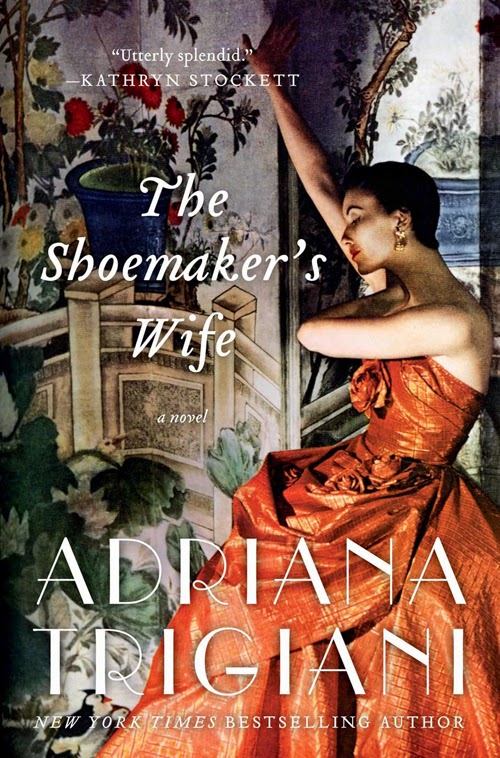
The Shoemaker's Wife 
  by Adriana Trigiani

     I was correct in my assumption I would like this novel. With all I've read about the author, I felt certain she would be a favorite for me, and now she is! I was mistaken in believing this novel to be the first in a series, as it is a stand-alone. However, I have begun reading Trigiani's Big Stone Gap series as a result of reading this book! And I am loving it, too. Have you read this book? Or any others Trigiani has written?
Image courtesy of author's website

Be sure to check out the other hosting bloggers' reviews:
Emily of The Bookshelf of Emily J
Ariel of One Little Library
Carolyn of Rosemary and Reading Glasses
Kay of whatmeread
Naomi of Consumed by Ink
(Two others are currently on hiatus.)

     One of the main themes that has stuck with me from this book is the reality that following the initial invasion of this land and virtual annihilation of its native peoples, it is the hoards of people who arrived by boat who further developed what would become the United States of America. Native Americans are the only non-immigrants to this land. It always amazes me that certain folks believe themselves to be above others in social status. Hello! Excepting members of indigenous Native American tribes, our ancestors all arrived in the same way as "immigrants," so no one of us is better than the other...but, I digress...
     The first 20 pages of this book described a scene I found heartbreaking and unimaginable--a mother with no choice other than to abandon her two sons to the nuns of a convent. Why? Because her husband is dead, it is 1905 in the Italian Alps, and she is destitute and ill...there were no "social safety nets" back then, if you had no family on whom to rely, you were on your own to survive. Fortunately for Ciro and Eduardo, these nuns were quite kind, caring, and compassionate toward them. However, due to one immoral and unethical priest, they were finally split up in their teen years--Ciro was shipped off to the U.S. to work as a shoemaker's apprentice and Eduardo enrolled in seminary. 
     Ciro had always been a hardworking soul and he not only learned, but very quickly excelled at this trade. Not long thereafter, Enza and her father departed the Italian Alps to work in the U.S., sending every spare bit of money back to build a real house for their family on the mountain: she as a seamstress and he as a laborer. Thus begins the start of several near-misses and actual meetings between Ciro and Enza during their young lives, following that first kiss on their Alpine mountain. (I was reminded of One Day by David Nicholls.) My heart broke for Ciro when he had finalized his preparations over the course of many weeks to properly "court [Enza] with the dream of marriage, when and if that was her desire," only to find she had moved from Hoboken, and he had no idea where to look for her or how to find her. 
     As a result of this disappointment, Ciro enlisted in the U.S. army to "see the world and do his bit." I had not realized that military recruitment at that time was aided by offering citizenship to those who served, making military service the fastest route for immigrants to become U.S. citizens. Simultaneously, Enza begins work at the Metropolitan Opera House, sewing costumes, and meets Vito Blazek, who demonstrates and offers her a luxurious lifestyle previously outside her realm of possibility. Although initially agreeing to marry Vito, she ends up marrying Ciro, traveling with him, Luigi and Pappina, to Minnesota to begin a new life in the U.S. western frontier. And the rest, as they say, is history... (You'll have to read it!)
     Trigiani's characterization and descriptive language are totally engaging and transported me back in time; I felt as if I was there with these characters! Enza and Ciro had an immediate and complete attraction for each other, one that far exceeded surface level; I believe they were indeed "soul mates" as we would currently term it... As they crossed the ocean together, Ciro tells Luigi, "Everyone should have what they want," remembering Enza had shared this belief with him in their brief interactions on "their mountain" just before his sudden departure. She was seemingly always in his thoughts and he in hers, though she tried to deny this to herself many times over. 
     I have always admired the courage of those who choose to relocate outside their country of origin, with no knowledge of the language, culture, or customs of that new country. Of course at the turn of the 20th Century, most people had little to no real knowledge of any country or culture other than that into which they were born. I can barely imagine the reality of landing in a new country, unable to communicate with anyone other than those few who also speak your native language, etc. Now that takes guts! This book truly brought the struggles and successes of such immigrants to me, and I feel as if I have a much better understanding of their challenges. Interestingly, this story was inspired by Trigiani's knowledge of her own ancestors' experiences. 

Now for our "wifely" questions...
1. What does this book say about wives or about the experience of being a wife?        
    Enza and Ciro were both introspective, realistic, and practical people. She realized that "...the life she'd always dreamed of, was about the family, not just two people in love. It was a fresco, not a painting, with details that required years of collaboration to create. A life with Ciro would be about family; a life with Vito would be about her." How insightful! This is why she chose life with Ciro, as she knew it would include caring about and loving others, not just someone loving her. Though as we later learn, Vito married at least three times, so it's quite likely he would not have remained as devoted to her throughout time anyway...or perhaps he was always dissatisfied with anyone but Enza. 
    Being a wife, especially in the early 1900's, was perhaps much more limited in scope than it is now. Although Vito obviously adored Enza, it was almost as if he "worshiped her from afar," without their having developed a deep-down friendship. Enza desired and/or needed much more than that from her lifelong relationship; she wanted to grow and develop as a person by interacting with and caring about others. A life with Vito would not necessarily have offered her such opportunity, but would have been a very self-centered superficial existence by comparison. This demonstrates that being a "wife" can have many different meanings.

2. In what way does this woman define "wife"--or in what way is she defined by "wife"?
     Literally, just as Enza is preparing to enter the church to marry Vito, Ciro arrives on the scene and stops her.
          "You would be mine."
          "This ring says I'm his." She showed him her hand, the ruby and diamond ring sparkled in the sunlight.
          "Take it off. You don't have to marry me, but you can't marry him."
          "Why not?" Her voice cracked beneath the strain of emotion.
           "Because I love you. And I know you. The man in that church knows the American Enza, not 
                the Italian girl who could hitch a horse and drive a carriage. Does he know the girl who sat by 
                her sister's grave and covered it with juniper branches? I know that girl. And she's mine."
           Enza thought of Vito, and wondered why she'd never told him about her sister Stella. Vito only         
                knew the seamstress to Caruso; he didn't know the Hoboken machine operator or the eldest 
                in a family who made it through the winter eating chestnuts, praying they would last until the 
                spring came. She hadn't told Vito any of her secrets, and because she hadn't, Vito was not 
                really a part of her story. Perhaps she had never wanted Vito to know that girl.
           "You can't come back here and say these things to me." Enza's eyes filled with tears. "I have a life. 
                A good life. I'm happy. I love what I do. My friends. My world."
           "What world do you want, Enza?" Ciro asked softly.                   (pages 310-311)
Enza realizes, "There would be such ease to life with Vito!" But in the end, "..she [was] meant to be with a man who understood her, down to her bones..." There were so many things involved in this exchange that revealed so much about these two people. Firstly, Ciro is an extremely kind, caring, and patient person, especially for a male of these times! Secondly, Enza is capable of deep introspection. Although she notes that "Life is a series of choices, made with the best of intentions, often with hope," she realizes those choices have brought her to this decisive point, and that the past does matter to her. I loved Ciro so much for offering his love and reasons, but allowing her to make her own choice, and offering her the option of not marrying either one of them. 
     I was struck by Enza's immediate reaction to Ciro, stating that wearing a ring indicates she belongs to a man--"I'm his." For the times, the idea of a wife belonging to a man or being owned by her husband was perhaps still quite acceptable, but for me, this was a shocker! Although Ciro was declaring some type of "ownership," it was based upon their shared experiences, heritage, and intimate knowledge of each other. Obviously, Enza desired to be much more than just a "wife" in these terms, as she was quite proud and satisfied that she could contribute her own money and work to a genuinely collaborative lifelong partnership with Ciro. 

If you've read this one, what was your reaction to it? What did you learn from it?


Image courtesy of
Macmillan website


Be sure to join us February 2, 2015, for our reviews of The Last Wife of Henry VIII by Carolly Erickson!

This one sounds fascinating!